
Wave Energy Conversion Modeling
NLR develops open-source, validated, and customizable wave energy converter (WEC) modeling tools that are freely available to the marine energy community.
These tools enable researchers and developers to analyze WEC performance, predict extreme loading in challenging wave environments, estimate potential power generation across ocean sites, and assess economic viability of device designs.
SEA-Stack enables high-fidelity modeling of wave-structure interactions using smooth particle hydrodynamics. This advanced simulation capability helps researchers understand how marine energy devices perform—and survive—under extreme wave conditions. Video from Project Chrono
To accelerate this work, NLR also leverages high-performance computing to run complex simulations faster, producing highly accurate and reliable data that help wave energy devices move from digital modeling to ocean deployment and, ultimately, the power grid.
Capabilities
Learn more about our wave energy conversion modeling capabilities.
NLR's modeling framework SEA-Stack, on GitHub, enables developers to de-risk technologies prior to deploying them. This open-source tool integrates multiple simulation technologies to design and optimize the next generation of WEC technologies. The backbone of SEA-Stack is HydroChrono, on GitHub, an emerging time-domain hydrodynamics simulation tool designed to model complex ocean systems.
SEA-Stack Approach
Modeling wave energy converters (WECs) involves four steps.

Existing Modeling Approach
exploration
optimization
modeling
analysis
The Time-domain Optimization Platform for WECs (TOP-WEC) combines software tools to optimize device shape and controls while maximizing energy capture. It provides a comprehensive modeling workflow, from hydrodynamic analysis to time-domain simulations and systemwide optimization.
To further enhance SEA-Stack's capabilities, NLR is integrating control co-design approaches using industry-standard robotics software. WECs are complex multibody systems whose energy output is highly sensitive to the timing and coordination between device motion and wave forces. By leveraging tools such as the Robot Operating System—commonly used in robotics for real-time control—and Simulink for system modeling, SEA-Stack can simulate both the physical dynamics of a WEC and the real-time response of its control system and onboard power management. This enables developers to test control strategies, simulate hardware interactions, and refine system designs before deploying devices in the ocean. Integrating the Robot Operating System also allows a seamless workflow from early modeling and prototyping to hardware-in-the-loop testing, accelerating the development of WECs with high technology readiness levels while reducing risk and cost.
Developed by NLR and Sandia National Laboratories, the Wave Energy Converter SIMulator (WEC-Sim) on GitHub is the leading open-source software for simulating how wave energy technology designs might perform once deployed. The software is flexible and can be adapted to many wave energy device types, operational scenarios, and control strategies. WEC-Sim enables developers, researchers, and industry professionals to evaluate device performance, optimize designs, and explore innovative wave energy technologies before they are deployed in real-world conditions.
Computational fluid dynamics enables detailed modeling and visualization of fluid-structure interaction phenomena that are difficult or cost-prohibitive to measure. In marine energy, computational fluid dynamics is especially useful for analyzing complex scenarios—such as extreme weather events, which impose highly nonlinear, transient loads on marine devices—that other tools cannot capture. Computational fluid dynamics simulations complement laboratory and open-water testing by providing insights into marine energy devices such as wave energy converters and marine turbines both before and during physical validation.
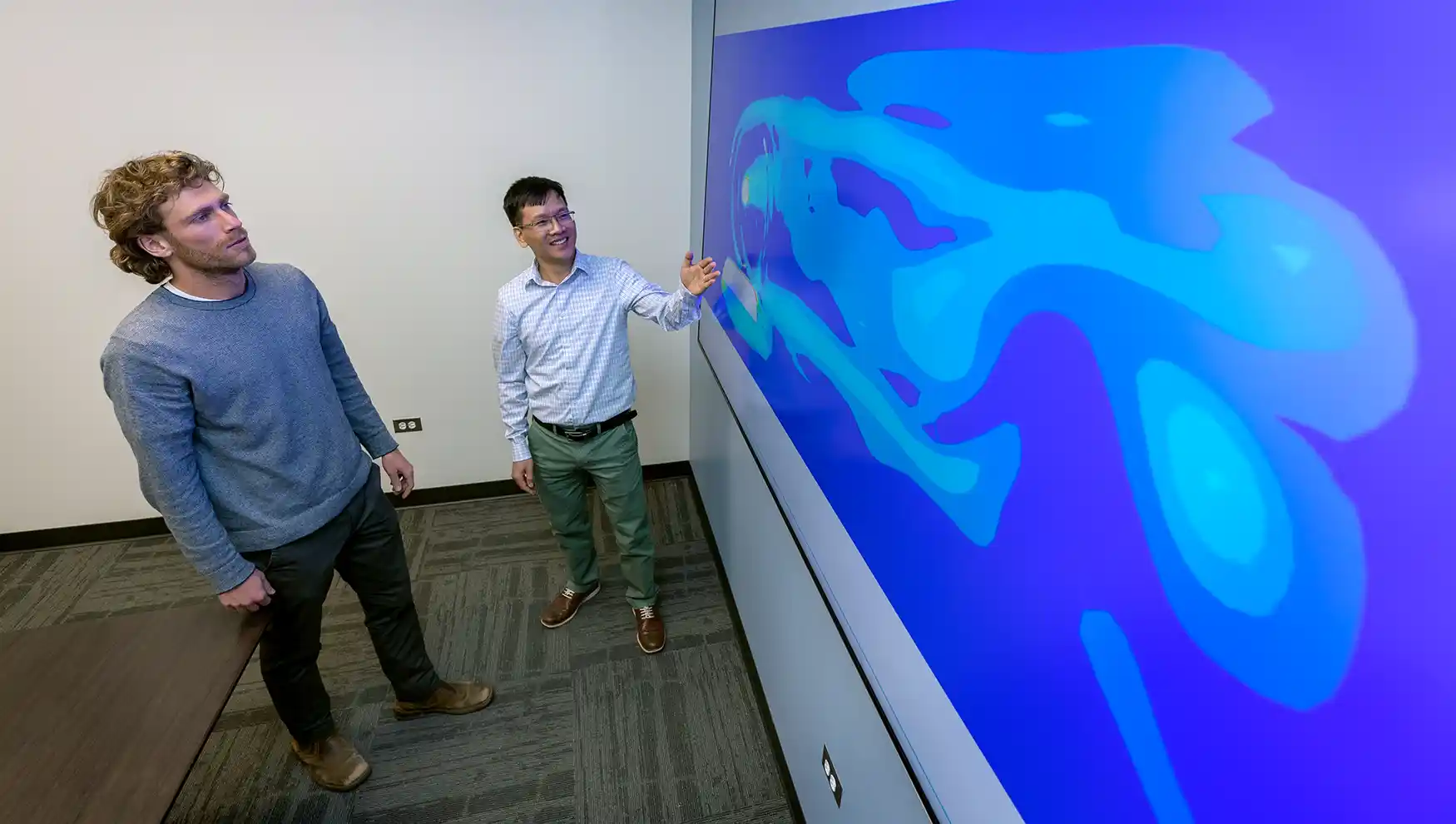
NREL water power researchers Thanh Toan Tran and Will Wiley review results from a computational fluid dynamics simulation of a cross flow marine turbine. Photo by Joe DelNero, National Laboratory of the Rockies
Researchers and developers can leverage WEC-Sim, SEA-Stack, and OpenFAST to model hydrodynamic performance and forces while testing real power take-off hardware to better understand system performance and improve numerical model representation of their technologies. Models for grid integration and blue economy applications can also be incorporated to evaluate full system performance and de-risk technologies before deployment.
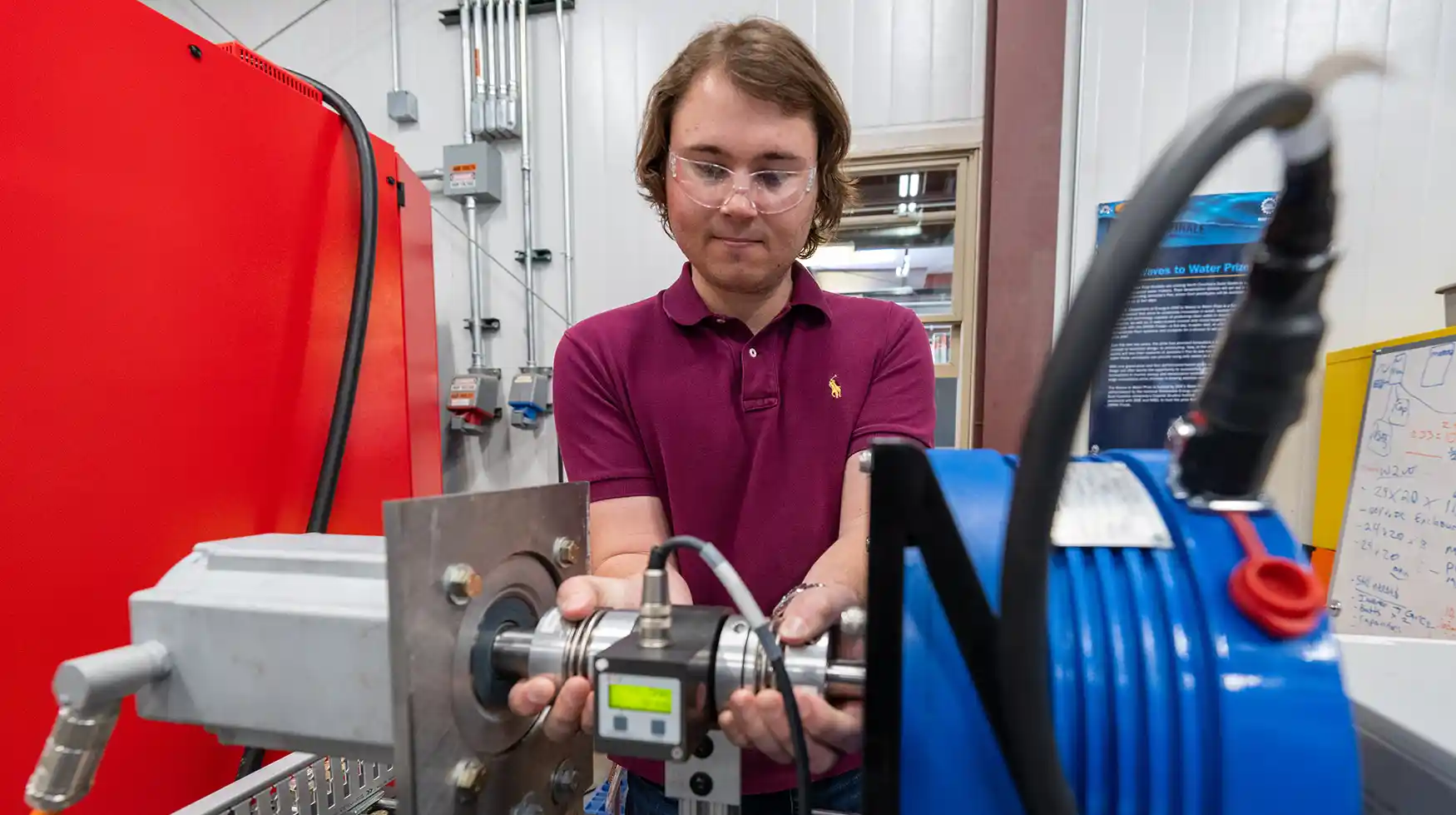
NLR water power researcher Casey Nichols is part of a team that develops hardware-in-the-loop testing for variable-geometry wave energy converters. Hardware-in-the-loop testing can produce a response to a physical power take-off system, measure that response, and use the recorded information to move through time. NLR has successfully coupled WEC-Sim to hardware-in-the-loop tests, blending digital and physical sources of information. Photo by Werner Slocum, National Laboratory of the Rockies
Publications
Resolving the Incompatibility of Hydrodynamics Calculations Between Popular Boundary Element Method Solvers, Proceedings of the European Wave and Tidal Energy Conference (2025)
Automated Design Exploration of the TALOS Wave Energy Converter Using the TOP-WEC Framework, Proceedings of the European Wave and Tidal Energy Conference (2025)
Beyond Wave Energy: Applications of the WEC-Sim Open-Source Software, Proceedings of the International Conference on Offshore Mechanics and Arctic Engineering, American Society of Mechanical Engineers (2025)
Review of Recent WEC-Sim (v6. 1) Advanced Features, International Marine Energy Journal (2025)
HydroChrono: An Open-Source Hydrodynamics Package for Project Chrono, Proceedings of the European Wave and Tidal Energy Conference (2023)
Contact
Share

Last Updated Dec. 18, 2025