
Cybersecurity and Artificial Intelligence
NLR is studying the relationship among artificial intelligence (AI), data centers, and electric infrastructure to tackle emerging and significant challenges in resource demand, grid stability, and cybersecurity.
Artificial Intelligence Use in Power Grids
As AI evolves and is integrated into more power grid operations, it can be used for cyber anomaly detection, smart load control, load forecasting, fault detection, and asset monitoring. Across the energy landscape, the ability to prevent, defend, withstand, recover from, adapt to, and attribute cyberattacks is affected by:
- The rapid increase in the volume and velocity of data and devices beyond human cognition
- The accelerating speed of automated device operation and response
- The rapid increase in the diversity of devices, systems, and users
- Complex cyber-physical interactions that complicate decision-making
- The ability of AI to offer trustworthy and timely decisions for safe and reliable operations.
Cybersecurity and Artificial Intelligence Pillars
NLR is working on solutions that address three pillars of AI and cybersecurity.
Security With AI
NLR employs AI for detection, prediction, and autonomous response to cyber activity in complex energy system environments. Projects aim to build fortified foundations for intelligent threat detection and monitoring, autonomous response and recovery, explainability and interpretability to enhance trust in AI models, and human-AI collaboration through the development of large language models, predictive risk models, and reinforcement and federated learning algorithms.
Security of AI
NLR is ensuring AI systems used in grid operations are robust, interpretable, and verifiable under adversarial and failure conditions. Researchers are studying existing AI security tools against cyberattacks and the potential consequences of disruptions. NLR also ensures the data centers that power AI are secure through device-level and system-level risk analysis and threat analysis. By leveraging combined cyber-physical system data in the Advanced Research on Integrated Energy Systems (ARIES) Cyber Range, NLR validates the security of data centers and develops, tests, and evaluates AI-based tools using techniques such as formal methods, zero-knowledge proofs, and explainable AI.
Security From AI
NLR is addressing risks from the malicious use of AI for autonomous cyberattack planning and execution at the software and firmware levels within devices and systems. Through AI-based offensive threat and vulnerability research, NLR conducts red teaming to understand how models may be used for automated network scanning, device discovery, and autonomous exploit generation that continually adapt to evolving operational technology environments and the threat landscape. This work helps the energy sector stay ahead of rapidly evolving AI-based threats through early detection of exploitable weaknesses and knowledge of how adversaries are leveraging AI.
The ARIES Cyber Range Advantage
Much of NLR's work in AI and cybersecurity is supported by the ARIES Cyber Range, a cyber-physical modeling, simulation, and emulation platform that advances the cybersecurity of energy systems. Within the cyber range, capabilities such as reinforcement learning, red team testing, and federated learning contribute to a deeper understanding of AI's role in energy systems—from secure and trustworthy AI for enhanced grid security to its malicious use by adversaries.
Projects
NLR is advancing research in autonomous energy systems to create tools and solutions for the real-time control and optimization of distributed energy resources. Researchers are working with power system experts to design cybersecurity into the decision-making methods of autonomous energy systems.
Cyber resilience of autonomous energy systems involves methods that dynamically reorganize cyber and energy networks into optimally resilient, stable, and secure configurations. NLR's work ensures that these dynamically arranged systems maintain integrity, privacy and resilience despite the difficulties of distributed data collection, ownership, and access.
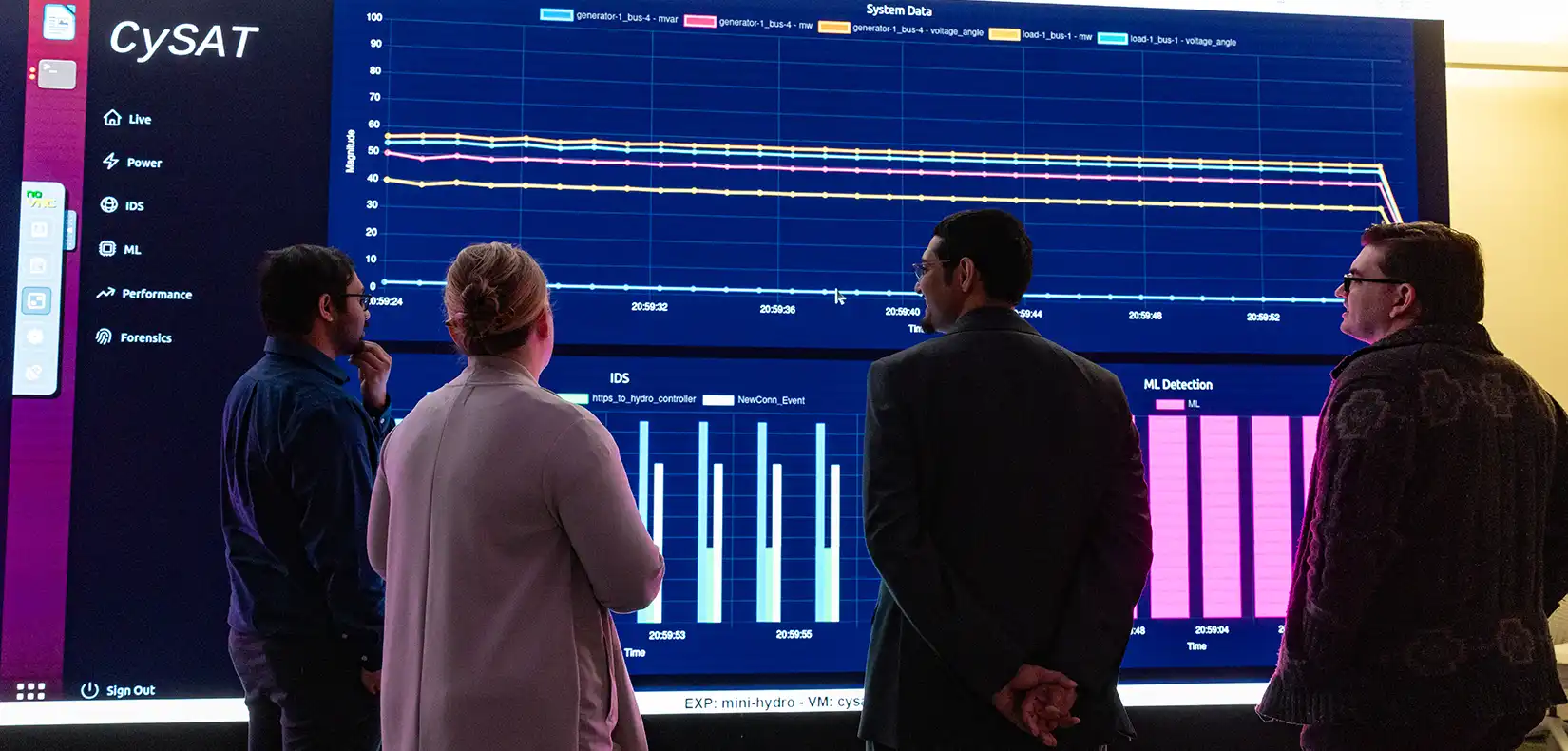
The Cybersecurity Situational Awareness Tool (CYSAT)—which leverages the ARIES Cyber Range—detects cyberattacks over hydropower and other distributed energy resource-integrated grid networks. The online tool will feature visualizations and threat detections and will be easily integrated into standard system operations.
The Cybersecurity Using Generative AI-Based Offensive and Automated Testing (Cyber-GOAT) project is developing an AI-powered tool to autonomously perform red team testing based on real-world attack scenarios in operational technology environments.
NLR supports the Mitigation via Analytics for Grid-Inverter Cybersecurity project, which aims to develop AI tools for detecting and mitigating attacks on groups of distributed energy resources. The project is sponsored by the U.S. Department of Energy's Office of Cybersecurity, Energy Security, and Emergency Response and involves Lawrence Berkeley National Laboratory, Siemens Corporate Technologies, Cornell Tech, and National Rural Electric Cooperative Association Research. NLR assesses vulnerabilities in the AI models by conducting adversarial exercises and red team testing in the ARIES Cyber Range.
Work With Us
NLR partners with grid operators, utilities, national laboratories, and others to develop and validate AI solutions for energy systems. Learn more about how to work with us.
Publications
ARM-IRL: Adaptive Resilience Metric Quantification Using Inverse Reinforcement Learning, AI (2025)
Designing Future Energy Systems With Generative AI, Computing in Science and Engineering (2025)
Demystifying Cyberattacks: Potential for Securing Energy Systems With Explainable AI, International Conference on Computing, Networking, and Communications (2024)
Verifying the Computational Integrity of Power Grid Controls With Zero-Knowledge Proof, Institute of Electrical and Electronics Engineers Power and Energy Society General Meeting (2023)
Reinforcement Learning Environment for Cyber-Resilient Power Distribution System, Institute of Electrical and Electronics Engineers Access (2023)
Contact
Share

Last Updated Jan. 8, 2026