
Explore our collection of new stories for this topic.
Search or filter for a specific story using the options below.
April 2016
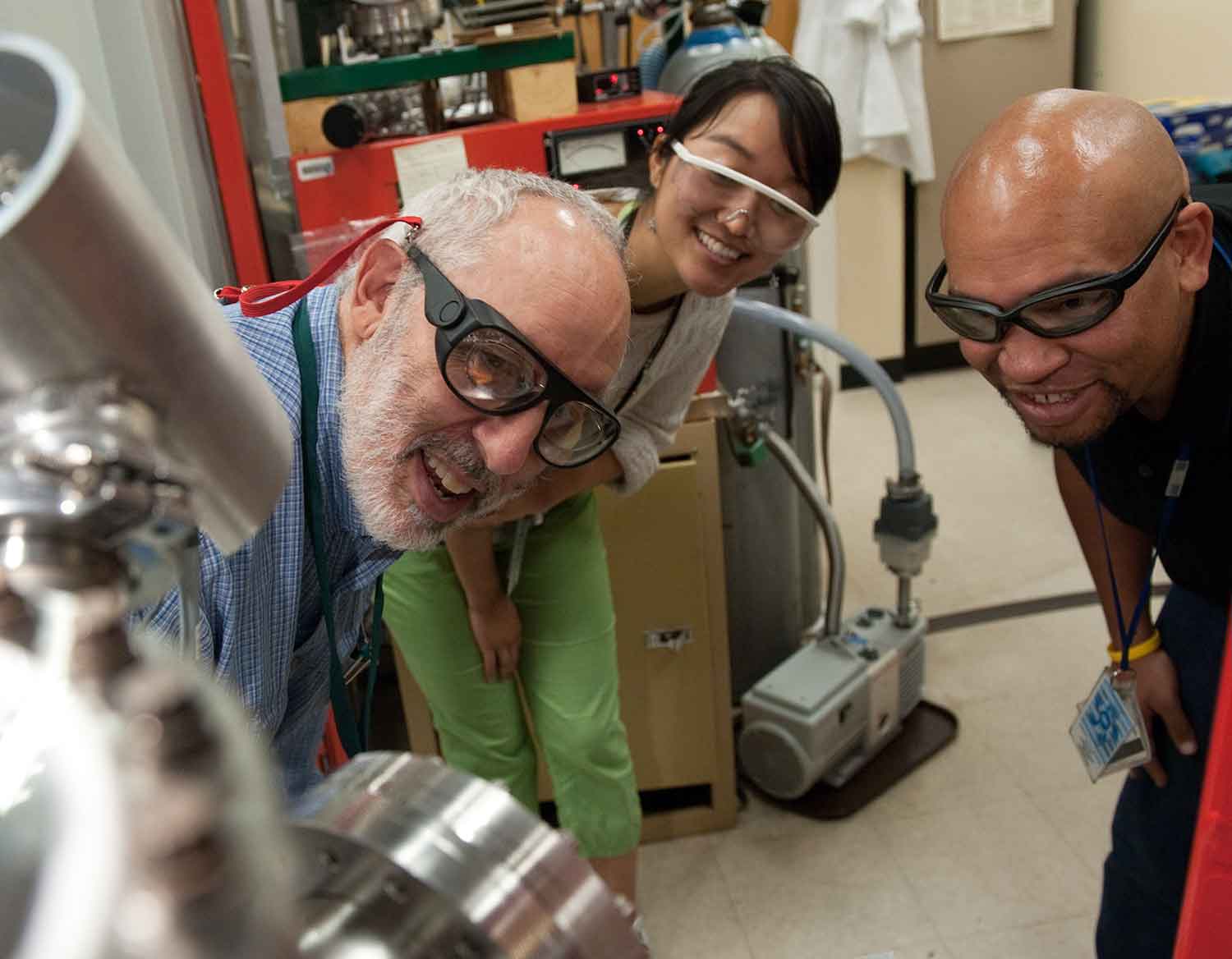
Researcher's Love for Science Starts with a Bang and Continues to Sizzle
NREL research fellow and chief scientist Dave Ginley's passion for science began at an early age—and continues to burn.
NREL Researchers Apply New Extreme Condition Wave Response Methodology
Extreme wave-induced loads are often the key cost driver for wave energy converter (WEC) designs. Therefore, in an effort to better understand the effects that extreme wave conditions can have on wave energy applications, researchers at NREL have applied a technique called the most likely extreme response method to evaluate the maximum displacement and loads of a point absorber WEC experiencing anticipated 100-year waves.
2015 Energy Systems Integration Facility Annual Report Calls to Industry: Bring Us Your Challenges
New report highlights research and achievements for the ESIF in its second year of operation.
NWTC Engineer Wins Prestigious International Electrotechnical Commission Award
Jeroen van Dam is proving that a single person can have a global impact. A principal engineer at the National Wind Technology Center (NWTC) at the National Renewable Energy Laboratory, van Dam recently received the International Electrotechnical Commission (IEC) 1906 award. This honor is bestowed on technical experts whose exceptional involvement in IEC activities has brought about significant advancements in international electrotechnical standardization. Since the award’s inception in 2004, three current NWTC experts have received it: Derek Berry, Arlinda Huskey, and Paul Veers.
Collegiate Teams on Track for May Competition
Twelve collegiate teams are gearing up for the biannual U.S. Department of Energy Collegiate Wind Competition 2016, to be held in New Orleans, Louisiana, May 23–25, 2016, in conjunction with the AWEA WINDPOWER 2016 Conference & Exhibition. Since the inaugural competition in 2014, the number of competing teams has increased—and so has the diversity—hailing from colleges and universities across the United States, including Alaska and Puerto Rico.
News Release: NREL Reveals Potential for Capturing Waste Heat via Nanotubes
A finely tuned carbon nanotube thin film has the potential to act as a thermoelectric power generator that captures and uses waste heat, according to researchers at the Energy Department’s National Renewable Energy Laboratory (NREL).
From Pump to Plug: Measuring the Public's Attitude about Plug-In Electric Vehicles
A new report by NREL's Mark Singer highlights what consumers really think about plug-in electric vehicles and what is needed to overcome widespread barriers to adoption.
Winds of Change Blowing for Wind Farm Research with NREL’s SOWFA Tool
Before the Energy Department's National Renewable Energy Laboratory (NREL) released its Simulator fOr Wind Farm Applications (SOWFA) simulation tool in August 2013, there had not been an open-source, freely available tool of this capability that researchers all over the world could embrace. Now, the winds of change are blowing.
NREL Research Proves Wind Can Provide Ancillary Grid Fault Response
When the Energy DEpartment commissioned a 1.5-megawatt (MW) wind turbine in 2009, it became a key player in improving the performance and lowering the costs of wind energy systems. In 2015, researchers at the National Wind Technology Center at the National Renewable Energy Laboratory in Golden, Colorado, connected the 300-foot-tall turbine to the controllable grid interface test facility, which simulates the real-time conditions of a utility-scale power grid. This began an ongoing, Energy Department-funded research effort to test how wind turbines can remain connected to the grid during short periods of grid failure.
One Step Closer to the Marketplace for State-of-the-Art Wind Turbine Drivetrain
National Wind Technology Center researchers at the National Renewable Energy Laboratory have entered the final phase of testing a next-generation drivetrain—the components of a wind turbine that convert the rotational energy of the rotor into electricity—that will be less expensive, more reliable, and more efficient. This project, funded by the Energy Department, combines innovations across the entire drivetrain system, including the gearbox, generator, and power converter.
Share

Last Updated May 5, 2025