
From Beta to Data: Marine Energy Analysis Tool Is Now Stable and Ready
Updated Tool Could Help Marine Energy Developers Save Time, Money, and Effort

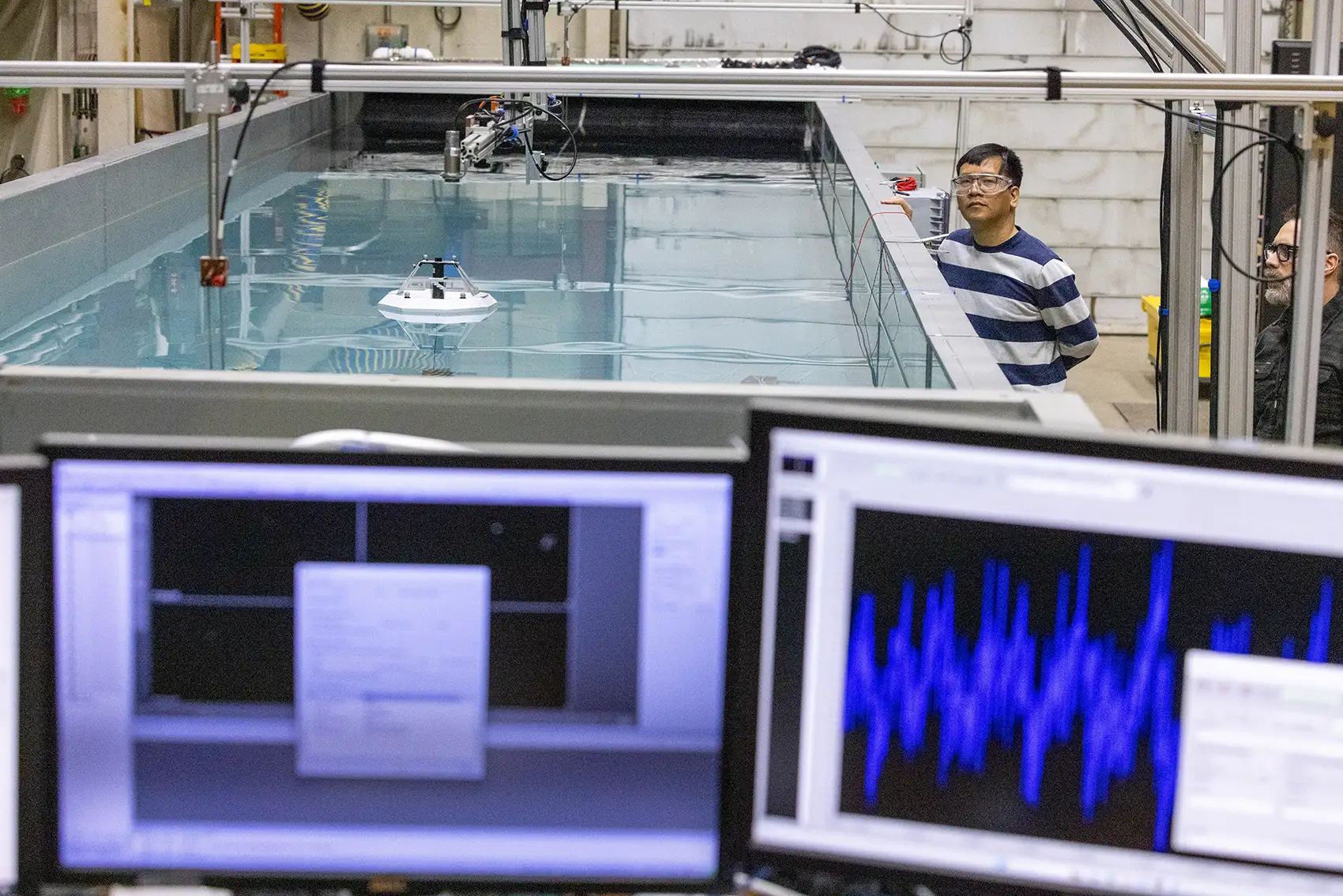
A team of national laboratory researchers recently released version 1.0 of the Marine Hydrokinetic Toolkit (MHKiT)—a free, publicly available software tool used to process, analyze, visualize, and standardize marine energy data.
Marine energy—energy generated from ocean and river waves, currents, and tides—could provide a reliable and abundant source of electricity for coastal and remote communities as well as for ocean-based industries. Since marine energy technologies are relatively young compared to other energy tech, developers are still honing promising but early-stage designs, narrowing in on the shapes, materials, and machinery that could survive an aggressive ocean environment while generating affordable, reliable energy.
To do all that, marine energy developers depend on data—data on their devices’ potential energy output, on the mooring systems that tether technologies to the ocean floor, on conditions at specific river or ocean sites, and much more.
That is a lot of data—an ocean’s worth. And not all marine energy developers and researchers have the background (or the months or money) needed to turn those numbers into answers.
“You could try to come up with your own data analysis solution if you want to, but that’s going to take a lot of time and money,” said Andrew Simms, a data scientist at the National Laboratory of the Rockies (NLR) who works with the laboratory’s water power researchers to validate marine energy technologies.
“MHKiT offers an efficiency gain, a consistency gain. It’s cost savings. It’s stability,” Simms added. “The tool gives you a head start and an idea of what you can find in the data right away—it’s almost instant feedback.”
Enhanced Data, Upgraded Platforms, and International Standards
MHKiT was initially released on GitHub in 2019. Between then and 2025, the team continually improved and updated the tool. Now, NLR researchers, along with collaborators from Sandia National Laboratories and Pacific Northwest National Laboratory, have released version 1.0, a stable, reliable tool that offers equivalent functionality in two platforms: MHKiT-Python and MHKiT-MATLAB.
Marine energy researchers and developers work in both Python and MATLAB. But, until now, those who prefer MATLAB could not access the same features as Python users. Version 1.0 features upgraded installation and run procedures that make the code more accessible in MATLAB. Users can access enhanced acoustic Doppler current profiler data and acoustic Doppler velocimeter data, which measure the speed and direction of water currents and water velocity. Previously, users could use MHKiT-Python to perform turbulence and mooring analyses and evaluate acoustics measurements—now they can do the same in MHKiT-MATLAB.
Trust and stability are not just critical for software users—they are critical goals for the emerging marine energy industry, too. Because the field is still rapidly evolving, many developers rely on standards set by the International Electrotechnical Commission (IEC) to design and build devices that can be trusted to perform safely, reliably, and as intended. The IEC team consists of international experts who design methods to evaluate a device’s power performance and other factors based on industry experience.
Adhering to IEC standards not only helps developers gain confidence in their designs’ potential; it also helps investors and potential customers trust the technologies. That earned confidence could make it easier for companies to achieve commercial success.
But IEC standards are not always accessible. The marine energy technical specifications are laid out in about 50 pages full of mathematical formulas. Not all marine energy engineers or scientists can translate that math into code that can be used to evaluate data on, for example, how much energy a device produced over a one-month ocean deployment.
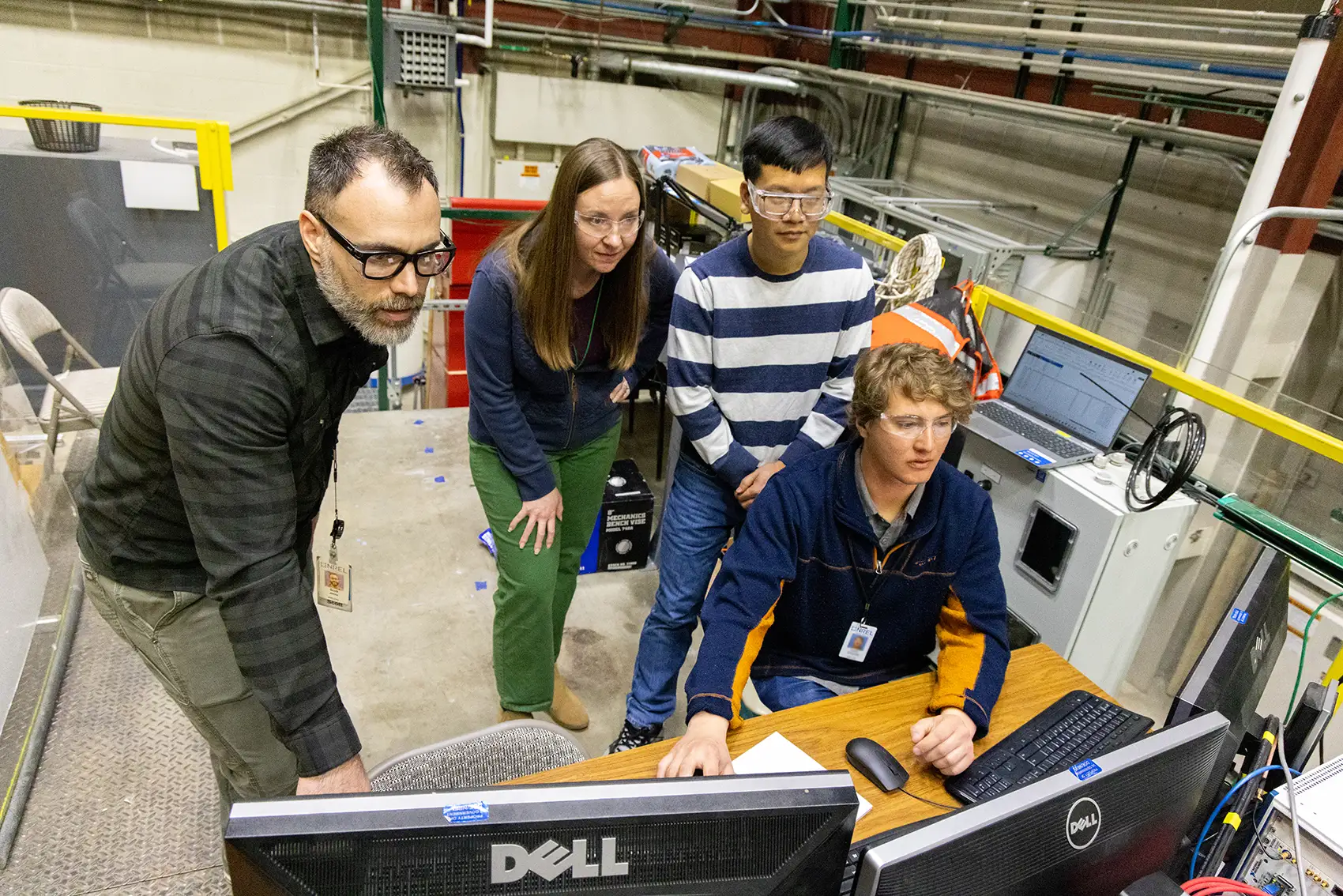
MHKiT does that technical translation for you thanks to the multilab team that built the tool. That team consists of marine energy experts from three national laboratories. All use the tool in their own work. Simms uses the tool every day. Other NLR teams have relied on it to process data for a wave-powered water purification device called the HERO-WEC as well as a wave energy converter deployed off the coast of Scotland.
Access to Ocean Data, Example Queries, and the Data Experts
Developers can also use MHKiT to review potential ocean sites and determine which might best suit their devices. By selecting a buoy off the coast of Hawaii, for example, a user can learn whether that area’s waves are too small to generate enough energy or too big, potentially causing too much wear for the device to survive long enough to be financially viable.
And if a company wants to stress test a promising design without the risk and costs that come with ocean field tests, they can simulate how their device might operate in ocean waves using another software tool, WEC-Sim (the Wave Energy Converter SIMulator). The designers can then analyze the data from their simulated tests in MHKiT, tweak their design based on those results, and go back to WEC-Sim for more simulated trial runs. This complementary software package makes it quick and easy to troubleshoot ideas and find the ones that could eventually master the waves.
Speaking of easy, the MHKiT team has created detailed installation guides, documentation, and example queries to help users navigate the tool. And they are eager for feedback. Any user can submit a bug or query directly to the MHKiT experts by clicking on the “New Issue” button on the Issues page on GitHub.
“If every engineer had to reinvent the data wheel every time, marine energy would get nowhere,” Simms said. “MHKiT is not reinventing the wheel. It’s getting back to square one of the problem we’re trying to solve, which is deploying commercial marine energy devices.”
Learn more about NLR’s research in marine energy and MHKiT. Then, subscribe to The Current—NLR’s water power newsletter—to stay up to date on the latest research.
Last Updated May 28, 2025