
Nora Riedinger's Path to Ocean Power
How a Collegiate Competition Boosted a Young Engineer Into Marine Energy

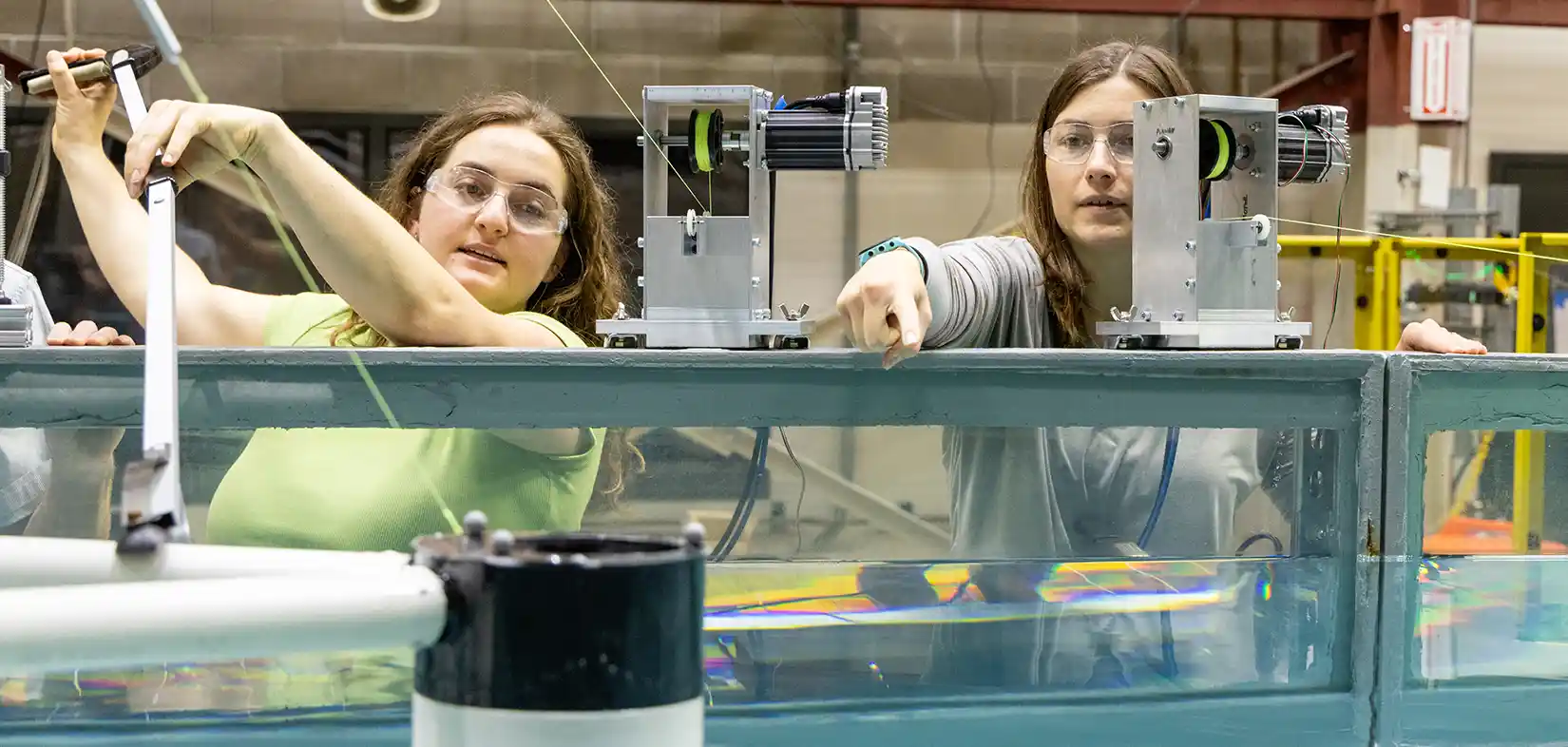
Nora Riedinger (left) was not sure how to build a career in the marine energy industry, which designs technologies that generate energy from ocean and river motions. Then, she joined a college competition. Photo by Gregory Cooper, National Laboratory of the Rockies
Early in college, Nora Riedinger knew she wanted a career in energy. But which kind of energy? Each had its own fascinating engineering conundrums to unravel and solve. How to decide?
In her senior year, Riedinger got sucked into the ocean—not literally, of course.
After competing in one energy-related collegiate competition year after year (rocketing from team member to team manager), she joined another, the Marine Energy Collegiate Competition, or MECC, for her senior project.
"I probably would have gone into something else if I hadn't done MECC," Riedinger said.
Funded by the U.S. Department of Energy's Water Power Technologies Office and administered by the National Laboratory of the Rockies (NLR), MECC brings together teams of undergraduates to design solutions to power the blue economy, which includes ocean-based industries—like seafood farms or oil and gas—as well as coastal towns and rural communities. All could benefit from the power produced by waves, currents, and tides—also known as marine energy.
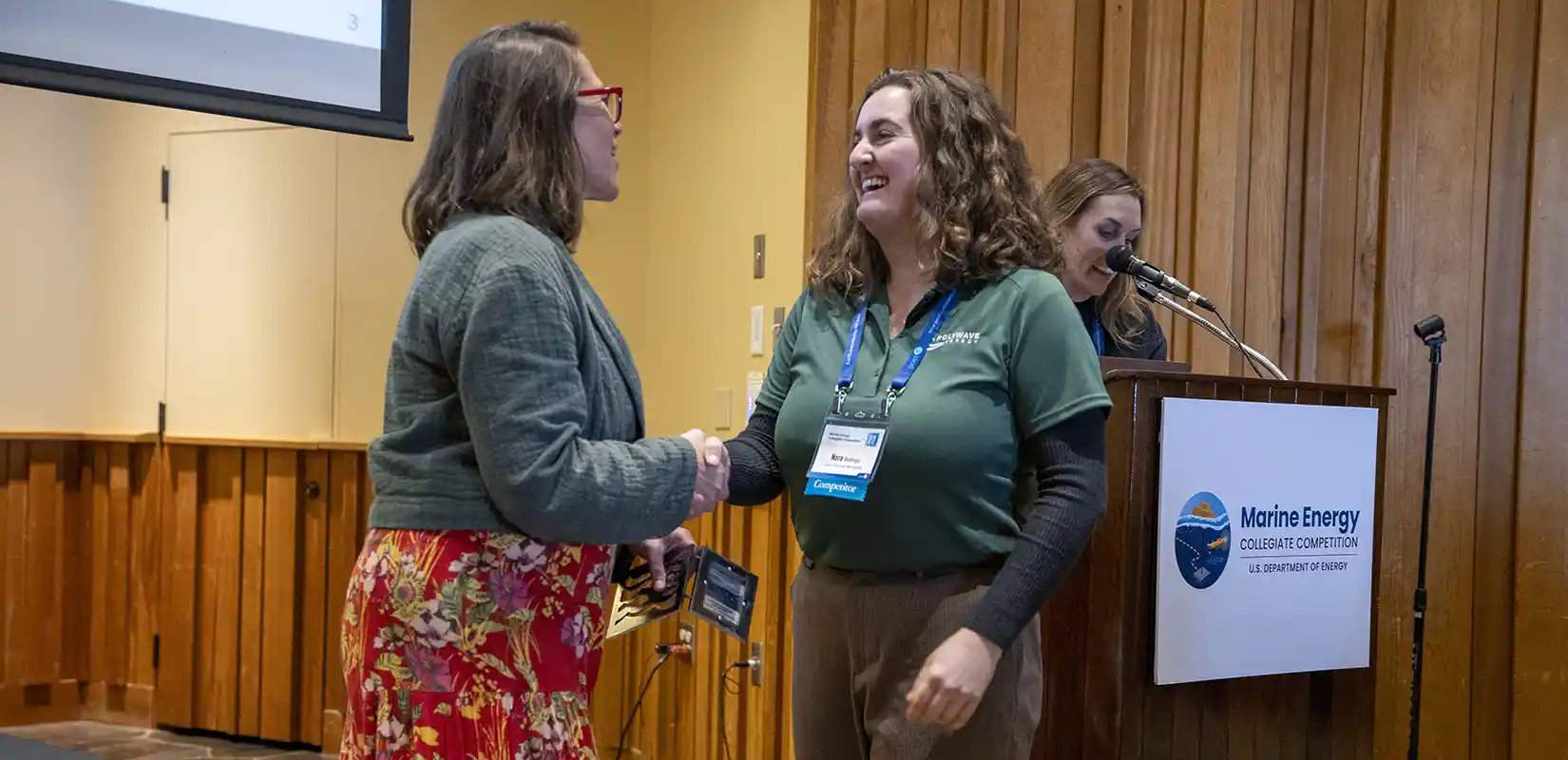
Although MECC was not Riedinger's first collegiate competition, she appreciated that the marine-energy-focused event was small and, therefore, more intimate, which made it easy to meet and build relationships with industry members, researchers, and national laboratory staff, like Arielle Cardinal (left). Photo by Taylor Mankle, National Laboratory of the Rockies
But marine energy is still in the early stages of development. Many young engineers like Riedinger do not know how, exactly, to join this growing workforce. And without a clear path for professionals to enter the field, industries and communities may not benefit from the potential of these powerful resources.
Riedinger liked the intimacy she found at MECC. The competition was smaller. The industry, too. And it helped that she grew up on the California coast. "There's no me without the ocean," Riedinger said. But, even if marine energy was edging out other potential energy careers for her, the young engineer was not sure which step to take next.
"How do we get into this world?" Riedinger remembers asking a researcher at MECC. "Do we need a master's? Do we need a Ph.D.? What is the path?"
The researcher's answer? "An internship at a national lab."
The Wave Energy Prototype and the Technical Advisor
Through MECC, Riedinger and her teammates "learned by doing," which they incorporated into their team motto.
The interdisciplinary team included students majoring in engineering and business entrepreneurship. Together, they pooled their skills to design, build, and test a functional wave energy device that could be used to power autonomous underwater vehicles (AUVs)—essentially, ocean drones. They also conducted market research, which showed their primary customers could be oil and gas industry members who use AUVs to safely and efficiently perform tasks at underwater structures, like welding, inspection, and spill prevention.
Today, most AUVs in the field must be charged manually by a team of people and a diesel generator. But wave energy offers a new way to power up. With the team's wave energy device, AUVs could hook up to a charging station underwater. That human-free power system could reduce injury risk, lower costs, and protect the environment, all while extending missions.
And this vision is not just theoretical.
After Riedinger and team built their device, they subjected it to simulated waves. Using wave data from the Gulf of America (where they would expect to deploy), they investigated environmental considerations, financial constraints, device durability and maintenance, part procurement, and more.
"The device was tested under six conditions and successfully generated power in all conditions," reads the team's report. "The device functioned as expected, showing promise for future marine power generation."
In short, the team got to do everything a marine energy developer would do. Or rather, they got to be marine energy developers.
"Especially with this project, I've grown to appreciate marine energy as something that has a little more room for development and being creative," Riedinger said. "It feels really exciting."
That is the same reason Hannah Ross, a mechanical engineer at NLR, chose a career in marine energy, too.
The Intern and the Swell Test Setup
Riedinger met Ross, one of the MECC technical advisors, at the 2024 competition. Riedinger met many marine energy researchers and industry members there. "At MECC, I made better connections," she said. "I got to talk to a lot of people about what they were working on."
One of those connections was Arielle Cardinal, the MECC competition manager and lead of NLR's water power workforce development portfolio. "Arielle was so wonderful," Riedinger said. So wonderful that, after MECC ended, she emailed Cardinal to see if the laboratory would be interested in hosting her as a Science Undergraduate Laboratory Intern (SULI), a program sponsored by the U.S. Department of Energy's Office of Science.
Lucky for Riedinger, Cardinal knew someone who was looking for an intern: Ross. And Ross was pleased to see how much hands-on experience Riedinger already had with computer-aided design (CAD) modeling plus building and testing both electronics and instrumentation.
"That's pretty rare outside of MECC," Ross said. "Based on that, it seemed like she could be a good fit for our wave tank testing."
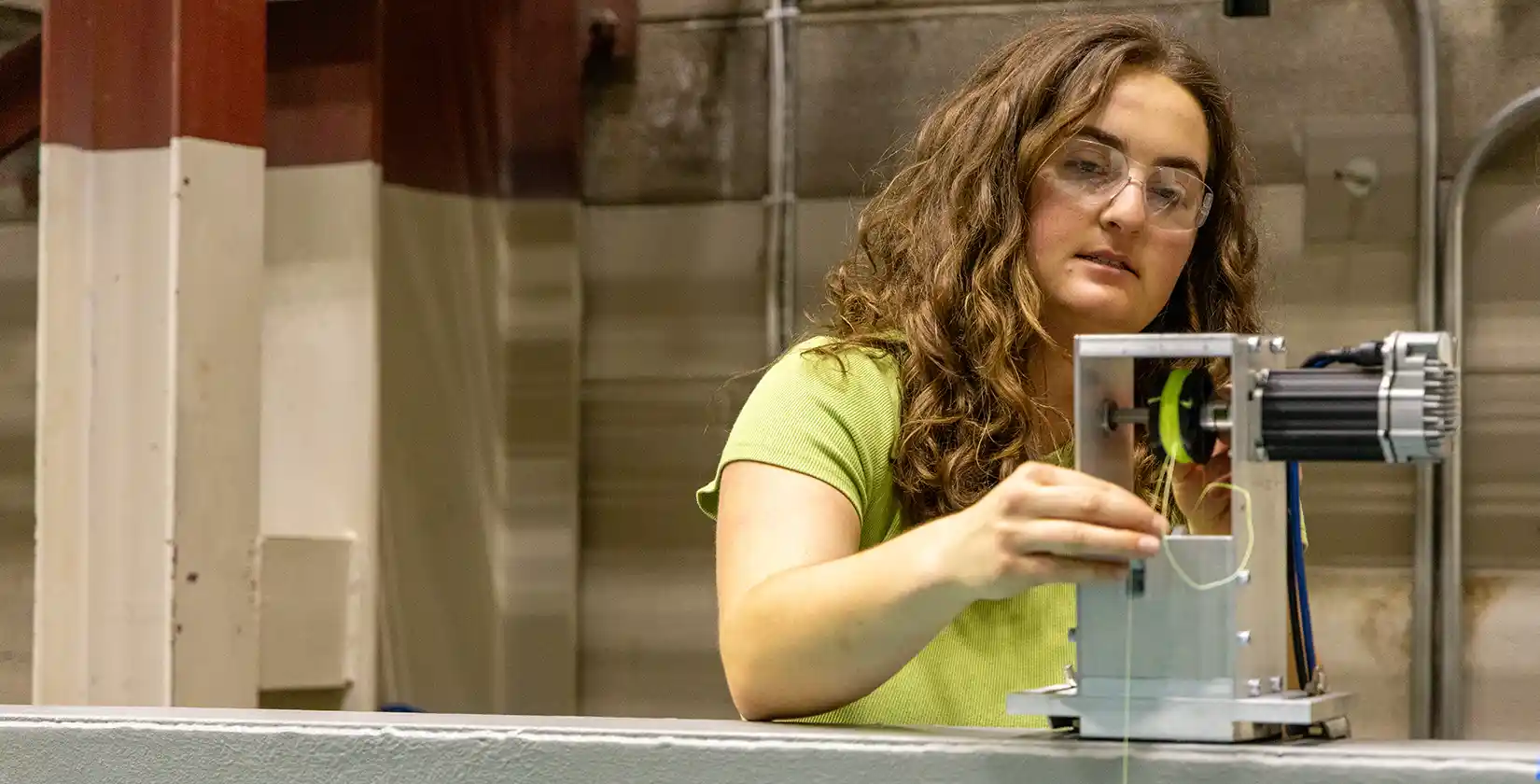
MECC gave Riedinger two big career boosts: hands-on experience in marine energy (a rarity for recent college graduates, according to NLR researcher Hannah Ross) and relationships with folks further down the marine energy career path. Photo by Gregory Cooper, National Laboratory of the Rockies
In January 2025, Riedinger took a tour of NLR's wave tank facility, the Sea Wave Environmental Lab (appropriately called SWEL), and her new project, which, like her MECC project, involved marine energy prototypes and test setups. But this time, she would design, build, and evaluate new hardware that could enhance SWEL, enabling the wave tank to recreate more forces, like currents or tugs from the mooring lines that tether devices to the ocean floor.
Riedinger once again used CAD to develop and refine tank testing hardware. She oversaw the build and made key decisions, like which parts to purchase and which to make in-house. She also integrated the new wave tank testing hardware into the tank's control system, nudging the whole test setup closer to the coveted hybrid model testing—in which real-world experiments in the wave tank get paired with computer simulations of ocean scenarios that cannot be replicated in the tank (not yet, at least).
"It's definitely been a challenge to take something completely from design all the way through manufacturing and testing mostly on my own," Riedinger said.
Toward the end of her internship, Riedinger led the preparation and presentation of a paper at the University Marine Energy Research Community conference in August 2025, building on the communication skills she developed on her collegiate competition teams.
"I have really loved NLR and would love to come back," Riedinger said.
She already has. After concluding her internship, Riedinger accepted a role as a full-time marine energy researcher at NLR. She followed the path.
Learn more about NLR's research in marine energy. Then subscribe to The Current, NLR's water power newsletter, to stay up to date on the latest research.
Last Updated May 28, 2025