
New Report Illuminates Geothermal Cooling Potential in Hawaii
University of Hawaii at Manoa and Lawrence Berkeley National Laboratory Teamed up To Analyze Feasibility of Geothermal Cooling Technologies


In areas with geologically recent volcanic activity and ample underground water flow, like the Hawaiian Islands, geothermal energy technologies present options to augment the electric grid.
To investigate building cooling and energy efficiency options, the University of Hawaii at Manoa’s Hawaii Groundwater and Geothermal Resources Center collaborated with scientists at Lawrence Berkeley National Laboratory through the U.S. Department of Energy’s Energy Technology Innovation Partnership Project (ETIPP).
Managed by the National Laboratory of the Rockies (NLR), formerly known as NREL, ETIPP supports remote, coastal, and island communities with technical assistance and energy planning to help them build more reliable and affordable energy systems. Communities apply for up to 24 months of technical assistance, and those communities drive the scopes and focuses of their energy projects.
University of Hawaii at Manoa joined the program in 2022 with a desire to explore geothermal options, and a new report from this project details the feasibility of developing shallow ground heat exchangers (GHEs) across Oahu and at a specific site on the island for cooling.
Geothermal heat pumps take advantage of relatively constant temperatures just under the earth’s surface, using GHEs to exchange heat with the earth. Through a system of looping pipes in the shallow ground, GHEs can move heat from a warm place to a cooler place, like how a refrigerator functions.
“High-temperature geothermal, which requires deep drilling, is required to produce electricity, but low-temperature geothermal such as GHEs, which can be accessed much nearer the ground surface, can be used for building heating and cooling, greatly lessening loads on the electric grid,” said Lawrence Berkeley National Laboratory’s Christine Doughty, staff scientist.
“I believe both types of geothermal have potential to be an asset to Hawaii,” added Nicole Lautze, founder and director of the Hawaii Groundwater and Geothermal Resources Center.
Determining Geothermal Cooling Favorability in Hawaii
In open-loop geothermal systems, wells are drilled to extract and inject groundwater, allowing the movement of thermal heat to and from the earth. These GHEs use cooler ground water from outside the system for the cooling process and expel the warmer water afterward.
In contrast, closed-loop GHE systems continually circulate a heat-transfer solution through pipes, which transfers heat to and from the ground via thermal conduction. Groundwater needs to have temperatures that are low enough to effectively cool buildings, and groundwater flow in a GHE system works to remove built-up heat.
Hawaii has far greater needs for cooling than for heating—meaning that GHEs would add heat to the subsurface and cause the systems to not function as desired. That is where groundwater comes in: It replaces heated water from the boreholes and maintains the functionality of the GHE system. Sufficient groundwater flow, then, is essential to the considerations for GHE deployment. GHE systems may not be deployed in areas with restricted watersheds or where there is subsurface production of freshwater. Therefore, closed-loop systems may be a more reasonable option in some locations.
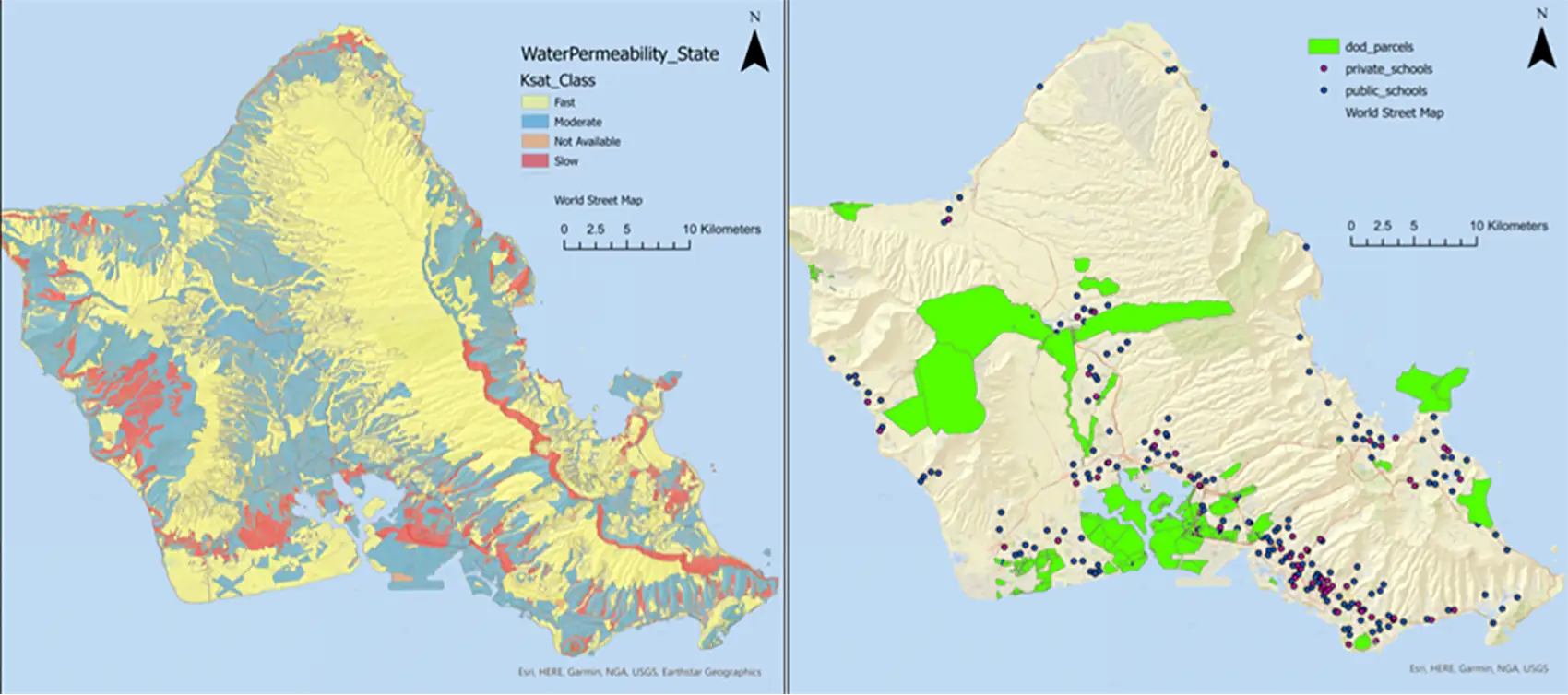
Numerous factors help determine whether a community or business may consider GHEs. Areas with older homes may lack efficient energy systems, and some organizations, like schools or government buildings, may prioritize more adaptive heating and cooling. Cultural considerations are also very important, and a new NLR report incorporates Hawaii communities’ perspectives on geothermal.
Economic factors are another big consideration, with the expense of deploying a system versus energy savings playing into overall cost. Modeling revealed that electricity and energy transfer demand decreased, and such reductions contributed to cost savings. Longer loan terms may help ease deployment expenses for geothermal systems.
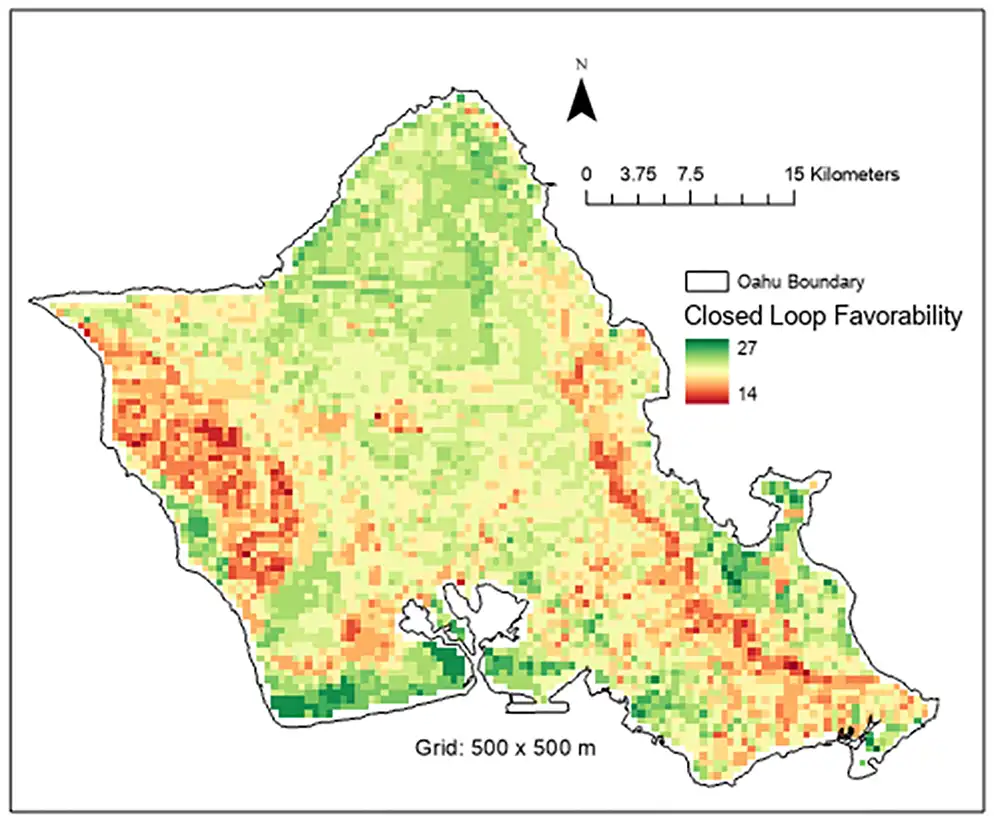
ETIPP researchers factored the above parameters into their analysis to develop favorability maps for closed-loop and open-loop GHE systems. They used specific geographic information system layers with 11 attributes—including elevation, geology, and soil permeability—to develop an overall favorability map for GHEs on Oahu.
For the site-specific feasibility analysis at the University of Hawaii at Manoa’s Stan Sheriff Center, researchers used a hydrogeologic model to analyze groundwater flow of a closed-loop system at the site. Restrictions on water quality—mandating that groundwater must be left in its natural state—diminished the available area for GHE system deployment across the island, while many coastal areas showed high favorability. Overlays showing potential customers and restricted areas sharpened the maps.
Geothermal Cooling Potential at University of Hawaii at Manoa
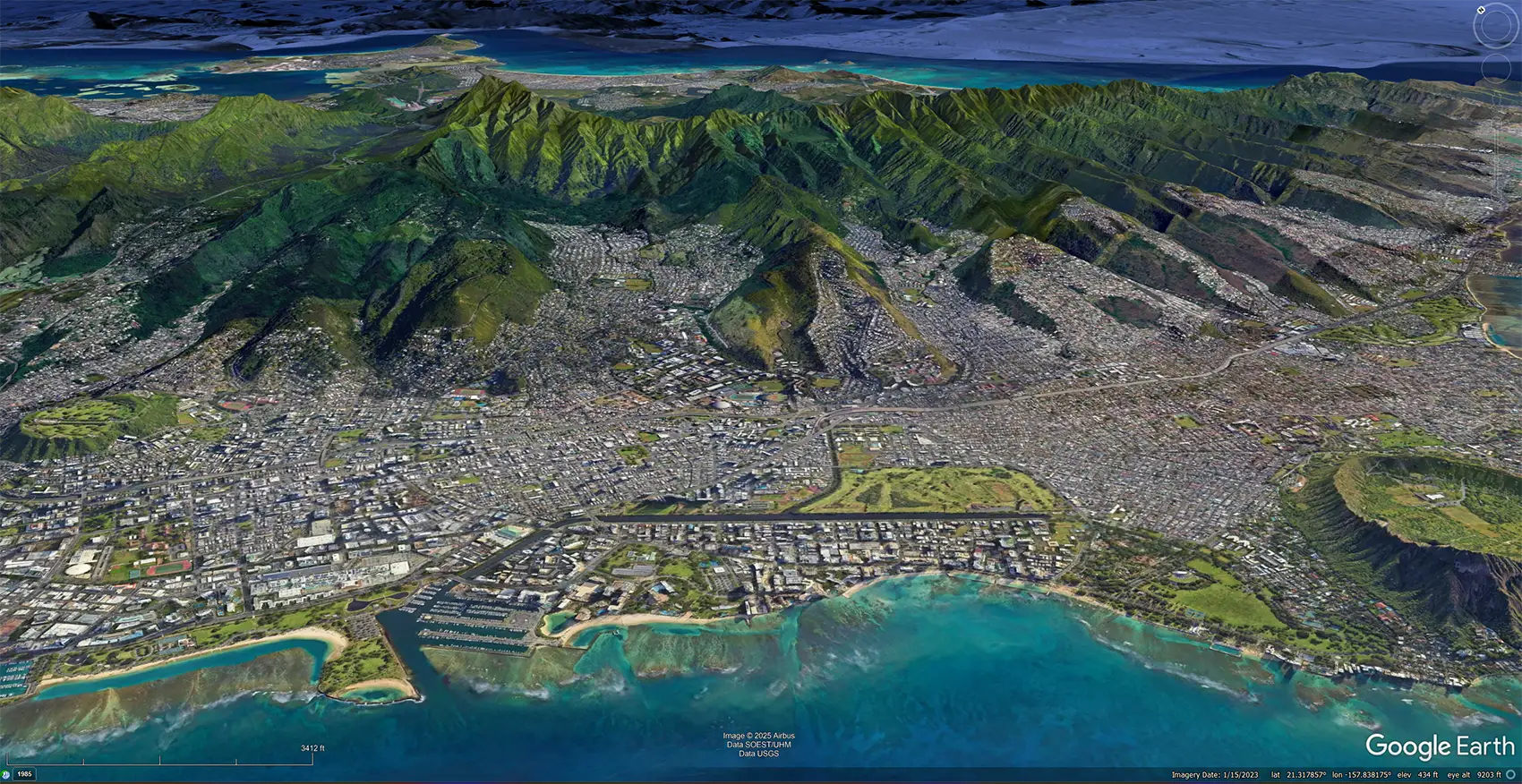
From the island-wide analysis, ETIPP analysis homed in and found that the Stan Sheriff Center at the University of Hawaii at Manoa, a building with a high cooling load in an area with lots of open space surrounding it, could make a good candidate for site-specific analysis of GHE technology.
Researchers used a hydrogeologic model to analyze a potential closed-loop system at the site. They modeled groundwater and heat flow, analyzed subsurface heat flow, and completed a techno-economic analysis.
Analysis without groundwater flow showed that the GHE system may operate normally in the first year, but heat buildup would increase water temperatures significantly after that, and without groundwater to sweep heat away, there would be increased chiller demand in years two through six. Modeling that incorporated groundwater flow—with similar conditions as the Stan Sheriff Center—showed that heat would be effectively swept away from the borefield, which would enable successful GHE operation for at least 10 years. Thus, including groundwater in analysis and planning—coupled with low interest loan rates and high capital investment—may provide economic benefits to the university.
Cold seawater may be an option for cooling-source systems, the analysis concluded, and such a system already operates at the Natural Energy Laboratory of Hawaii. The report authors encouraged further study.
As in Hawaii, ETIPP continues to help communities explore geothermal and other technologies to help meet their energy needs through in-depth, collaborative investigation of potential solutions.
“This ETIPP project established a strong collaboration with LBNL and the foundation for what I hope is additional grant funding to explore the potential of GHEs on the UHM campus and across the state to cool buildings and reduce load on Hawaii’s grid,” Lautze said.
The U.S. Department of Energy’s Energy Technology Innovation Partnership Project (ETIPP) is a community-led technical support program for coastal, remote, and island communities to access unique solutions and increase energy reliability. By uniting federal agencies, national laboratories, regional organizations, and community stakeholders, ETIPP provides tailored technical support to help communities achieve affordable, reliable solutions to their energy system challenges. This collaborative model leverages the combined expertise and resources of its partners to deliver comprehensive, practical solutions that align with local needs. Learn more about ETIPP.
Last Updated May 28, 2025