
28 Local Leaders To Join Peer-Learning Cohorts on Two New Energy Topics
Energy to Communities (E2C) Launches Six-Month Peer-Learning Cohorts on Successful Energy Project Implementation and Planning for Major Energy Disruptions in the Southeast

The National Laboratory of the Rockies (NLR), formerly known as NREL, is excited to announce the 28 local participants across 14 states, territories, and Tribes selected for two new Energy to Communities (E2C) peer-learning cohorts, managed on behalf of the U.S. Department of Energy (DOE).
These cohorts bring together local leaders, energy experts, and community organizations to tackle critical challenges related to project implementation and planning for region-specific energy challenges.
“These E2C peer‑learning cohorts let us introduce new topics that directly address evolving needs nationwide,” said Jenny Sumner, the E2C program lead at NLR. “We’ve now delivered cohorts on 17 topics covering a wide range of issues, including the two cohorts wrapping up this month on navigating electricity load growth and engaging with electric utilities to build successful local partnerships. We look forward to building on this momentum and equipping participants with the tools and expertise needed to strengthen their energy futures.”
Participants from nearly 250 communities have participated in E2C peer-learning cohorts for educational resources, case studies, analysis and modeling tools, templates, trainings, and facilitated collaboration.
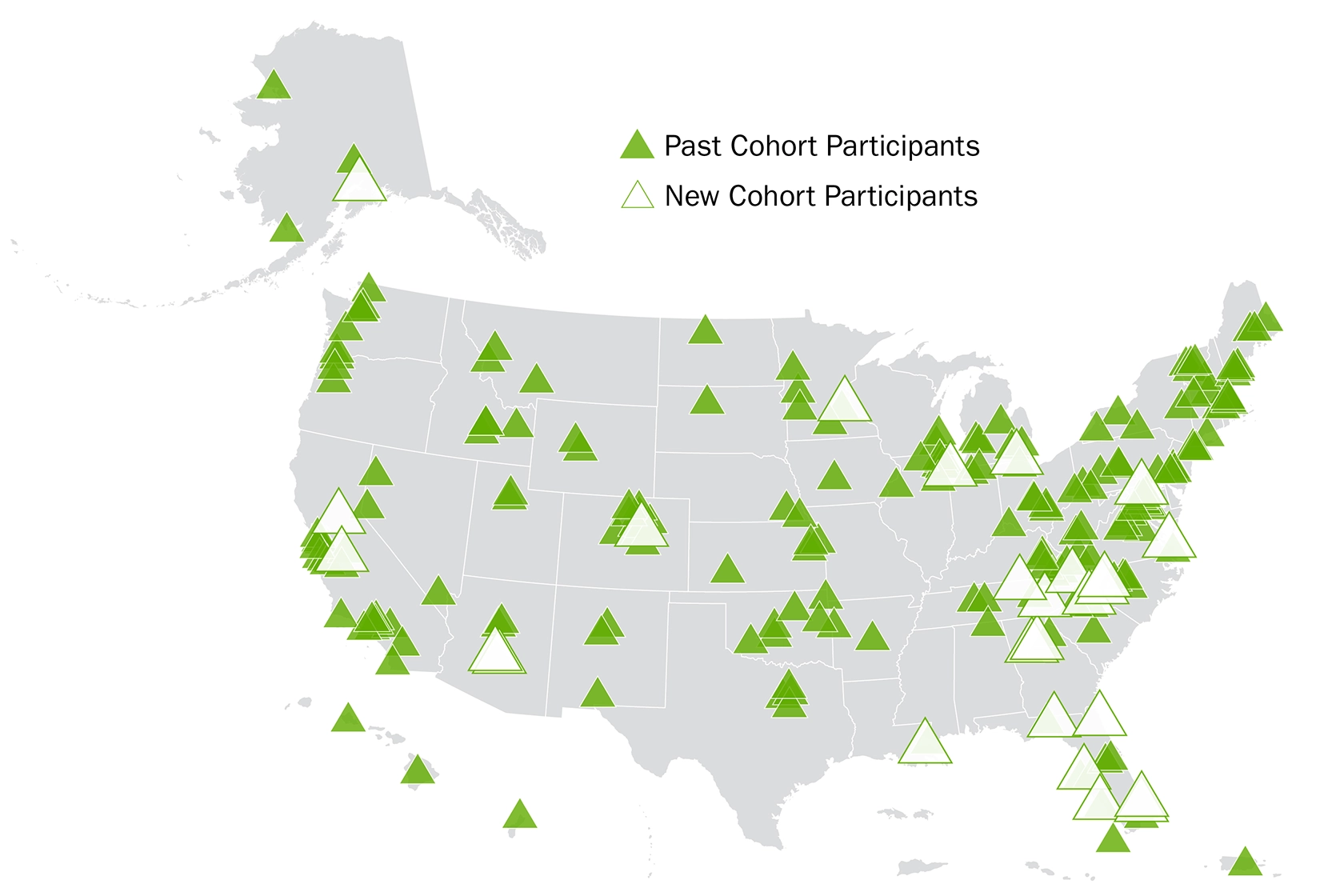
Beginning in January 2026 and continuing through June, the upcoming cohorts will bring participants together each month to learn from energy experts—and from one another—while exploring best practices, strategies, and tools to advance their energy goals. The two cohorts in this round are focused on successful energy project implementation and planning for major energy disruptions in the Southeast.
Successful Energy Project Implementation
In an era when reliable, secure, and abundant energy is essential, success depends on moving from technical assistance to on‑the‑ground deployment to ensure projects deliver real results.
In the Successful Energy Project Implementation cohort, participants will explore common challenges in implementing energy projects and learn strategies to turn project plans into reality. Each participant will focus on a local energy project or priority as a cornerstone for their learning throughout the series. Workshops will provide opportunities to improve project planning, develop strategies to build internal and external stakeholder buy-in, identify new funding and financing avenues, and accelerate siting, procurement, and project execution.
Cohort activities are designed to address the significant obstacles that often prevent tangible progress.
“I’ve seen many local leaders develop ambitious plans to strengthen their energy systems, only to watch those ideas stall,” said Allison Smith, a senior project manager at NLR. “Turning energy projects into reality requires overcoming significant hurdles—securing funding, building consensus, and navigating permitting and regulations. I’m excited to work with this new cohort to identify those challenges and develop strategies to successfully move projects forward.”
Benjamin Pushka, of Lucas County, Ohio, joined this peer-learning cohort to connect with others who have successfully overcome implementation obstacles.
“Our community has been exploring new energy solutions for years. We are excited to join this cohort and gain additional support and expertise to bring those ideas to life,” Pushka said.
The participants in this new cohort include project and program managers, energy professionals, and representatives from nonprofit organizations.
Participants in the Successful Energy Project Implementation cohort:
- Boone, North Carolina
- Chugachmiut (Anchorage, Alaska)
- The Center for Native Health (Cherokee, North Carolina)
- Denver, Colorado
- East Tennessee Clean Fuels Coalition (Knoxville, Tennessee)
- Gary, Indiana
- Knoxville, Tennessee
- Latino Coalition of San Benito County (San Benito County, California)
- Board of Lucas County Commissioners (Lucas County, Ohio)
- New Orleans, Louisiana
- Phoenix, Arizona
- Ramsey County, Minnesota
- Tebughna Foundation (Anchorage, Alaska)
- Tempe, Arizona
- Three Sisters Gardens (West Sacramento, California)
Planning for Major Energy Disruptions in the Southeast
Regions across the country face unique challenges, requiring local leaders to develop customized strategies that maintain energy services through severe and unpredictable weather conditions.
In the Planning for Major Energy Disruptions in the Southeast cohort, entities across the southeastern United States will explore strategies to plan for, prevent, and mitigate impacts to energy infrastructure caused by extreme events, such as severe weather. Cohort participants will identify opportunities to integrate energy systems thinking in their emergency planning processes, learn about grid infrastructure and utility operation, and evaluate trade-offs of energy system investments.
Jordan Burns, a researcher at NLR, emphasized the importance of bridging disciplines.
“I've spent my career in both emergency management and energy systems planning, and I’m excited to work with this cohort to help connect the two,” Burns said. “Preparing for energy disruptions requires more collaboration between emergency managers, community planners, and energy system operators—this cohort will connect local insights with practical strategies to foster that collaboration.”
That perspective resonates with local leaders. Chloe Davis of the Piedmont Triad Regional Council noted the real-world urgency.
“We’ve experienced the impact of severe storms firsthand,” Davis said. “Being part of this cohort allows us to plan smarter, protect our residents, and recover faster when storms hit.”
The participants in this new cohort include emergency management professionals, energy professionals, and representatives from place-based nonprofit organizations engaged in energy planning.
Participants in the Planning for Major Energy Disruptions in the Southeast cohort:
- Boynton Beach, Florida
- The Center for Native Health (Cherokee, North Carolina)
- Charlotte-Mecklenburg Emergency Management Office (Charlotte, North Carolina)
- Davidson County Emergency Management (Davidson County, North Carolina)
- Decatur, Georgia
- Delray Beach, Florida
- DSR Public Health Foundation Inc. (Greenville, Florida)
- Environmental Community Action (Atlanta, Georgia)
- Howard County, Maryland
- Knoxville, Tennessee
- Piedmont Triad Regional Council (Kernersville, North Carolina)
- Sanibel, Florida
- St. Johns County, Florida
- St. Petersburg, Florida
- Virginia Beach Department of Emergency Management (Virginia Beach, Virginia)
Learn more about E2C’s three different technical assistance offerings, and apply for short- term Expert Match support today.
Peer-learning cohorts are one of three technical assistance offerings from the E2C program, ranging from short-term technical assistance to address near-term energy challenges to more in-depth technical partnerships that support communities in developing abundant, reliable, affordable, and secure energy systems.
E2C is funded by DOE’s Office of Critical Minerals and Energy Innovation and managed by NLR with support from Argonne National Laboratory, Lawrence Berkeley National Laboratory, Oak Ridge National Laboratory, and Pacific Northwest National Laboratory.
Learn more about E2C.
Last Updated May 28, 2025