
Grid Modernization News
Explore our archive of grid modernization news stories.
38 Coastal, Remote, and Island Communities To Pursue Energy Reliability via Energy Technology Innovation Partnership Project
Latest Cohort Is Program’s Biggest Yet, With Broad Geographic Representation

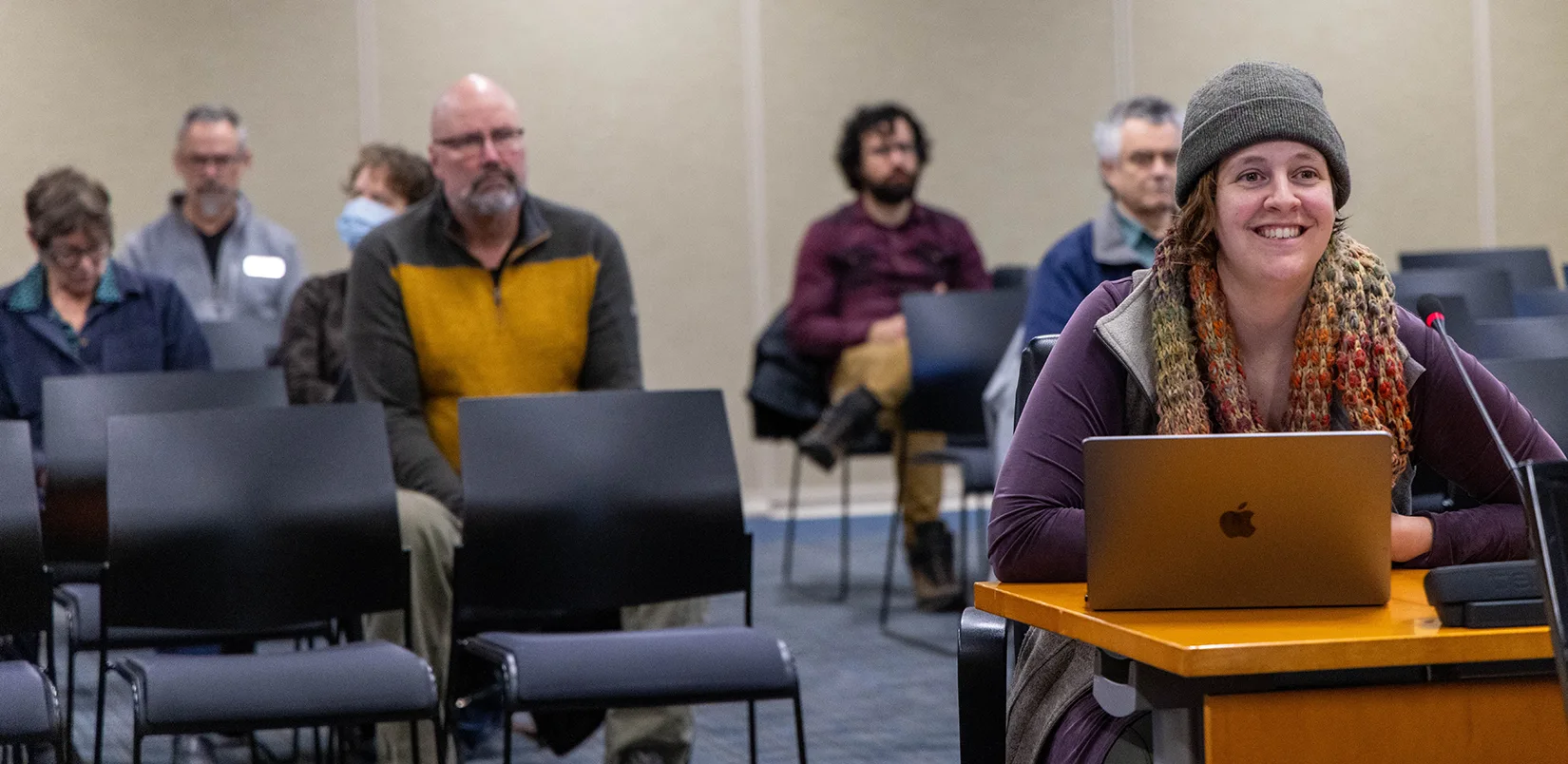
Residents from the Sitka, Alaska, area and representatives of the Energy Technology Innovation Partnership Project (ETIPP) discuss the community’s ETIPP work at a planning commission meeting in Sitka. Photo by Brittany Falch, National Laboratory of the Rockies
Remote and island communities face unique energy challenges—but these challenges also present unique opportunities to increase energy affordability, reliability, and security.
In their efforts to address their energy challenges, 38 coastal, remote, and island communities will receive support as part of the fifth cohort of the Energy Technology Innovation Partnership Project (ETIPP)—a U.S. Department of Energy technical assistance program led by the National Laboratory of the Rockies (NLR), formerly known as NREL.
ETIPP connects selected communities with national energy experts who provide technical analysis, modeling, and decision support to identify energy reliability and affordability solutions best suited to each community’s needs.
Several new Gulf Coast and Great Lakes communities have joined the program this year, adding to the program’s regional expansion in 2024. The communities joining ETIPP’s fifth cohort strengthen the program’s presence across these regions, as well as in Alaska, the Caribbean territories, Hawaii and the Pacific territories, the Northeastern Seaboard, the Pacific Northwest, and the Southeastern Seaboard.
“We’re fortunate to be able to expand the program to so many communities this year,” said NLR’s Tessa Greco, ETIPP program manager. “The growth of the program showcases its value to coastal, remote, and island communities, while interest in the program highlights the energy challenges so many communities face.”
Proposed projects for Cohort 5 aim to strengthen energy systems against extreme weather events, explore options for new local generation, design microgrids to protect against outages, explore energy efficiency options, and more.
Communities in the early stages of energy planning will spend 4–8 months in ETIPP developing a strategic energy plan that clearly defines their energy goals and objectives. Those joining ETIPP with an existing energy plan or well-defined project will begin a 12–24-month process to analyze and validate specific energy solutions.
A team of national laboratory researchers and regional partner organizations will support ETIPP communities along the path, no matter which track they take. Energy experts at four national laboratories—Lawrence Berkeley National Laboratory, the National Laboratory of the Rockies, Pacific Northwest National Laboratory, and Sandia National Laboratories—work with communities to find solutions tailored to local energy challenges. ETIPP communities also receive support from regional partners, who build connections between community members and the national laboratory complex and have the local knowledge to ensure that projects are meeting community needs.
In ETIPP's first four cohorts, 57 communities analyzed reliable energy solutions, such as assessing localized energy generation and storage options, optimizing existing energy systems, or analyzing energy efficiency and weatherization options for existing infrastructure.
Learn more about ETIPP’s Cohort 5 communities and their planned projects below.
ETIPP’s Fifth Cohort of Communities
ETIPP is a community-led technical support program for coastal, remote, and island communities to access unique solutions and increase energy resilience. By uniting federal agencies, national laboratories, regional organizations, and community stakeholders, ETIPP provides tailored technical support to help communities achieve affordable, reliable solutions to their energy system challenges. This collaborative model leverages the combined expertise and resources of its partners to deliver comprehensive, practical solutions that align with local needs.
To learn more about program eligibility and the application process, visit NLR’s ETIPP website or contact [email protected].
Share
Last Updated March 10, 2025