
Education Resources for Students
Students can explore how to use energy to create a better energy future by using these resources, developed and organized by grade level by NLR's education team.
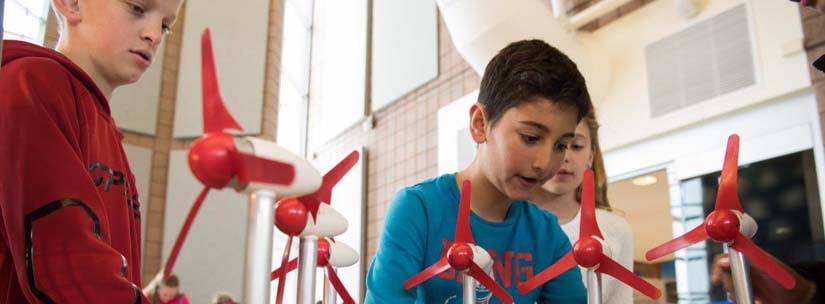
Kindergarten–Third Grade
Watch our educational Storytime series on YouTube.
Fourth–Eighth Grade
Activities and Experiments
Learn energy basics, and then put your knowledge to practice with these resources.
Activity: The Power of the Wind
Experiment: Building a Biomass Battery
Experiment: Building Series and Parallel Circuits
Experiment: Combining Energy Sources
Experiment: Electrons
Spark Squad Comic Book
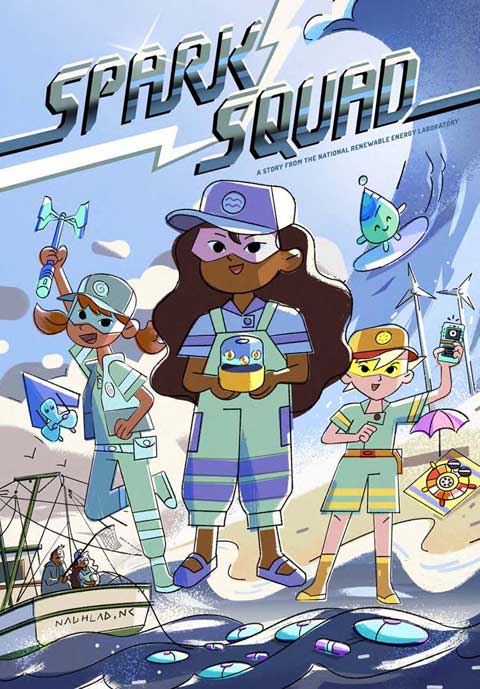
The future of energy relies on the next generation. To inspire students to explore energy, NLR partnered with the U.S. Department of Energy's Water Power Technologies Office to create the Spark Squad comic book series and complementary educational activities.
The first Spark Squad comic follows middle school students Jasmine, Aria, and Thomas as they learn about joules and marine energy (power generated by wave motion) in preparation for their power fair. In Volume 2, the trio is joined by Asher and his Uncle Frank as they explore a hydropower facility, where they learn how a dam operates and helps the environment.
Additional Resources
For energy- and environment-related lesson plans, projects, and other activities for grades K–12, visit the Climate Literacy and Energy Awareness Network or see our Energy Basics page to learn more about renewable energy resources.
The Algae Academy is a K–12 module that teaches the fundamentals of algae and how it can be used as a source of renewable energy. The program provides free STEM kits that include daily lesson plans, laboratory supplies, live algae, and more for students to complete the curriculum and grow algae in their classrooms.
The U.S. Department of Energy's Center for Bioenergy Innovation (CBI) has taken a novel approach to bioenergy education and outreach by engaging fourth–eighth grade students using CBI-developed lesson plans in bio-based energy production and utilization. CBI is working with the Creative Discovery Museum in Chattanooga, Tennessee, to refine, develop, and test a Next Generation Science Standards curricula to match evolving CBI goals. The lessons include basic concepts such as the carbon cycle, lignocellulosic biomass as a substrate for the production of biofuels and bio-products, and genetically modified organisms as well as technical and economic obstacles to a bio-based economy.
Share

Last Updated Dec. 7, 2025